Friday, 29 December 2017

Christmas 1 – 31 December 2017 – Year B

Grace to you from God our Father and our Lord and Saviour Jesus Christ. Amen
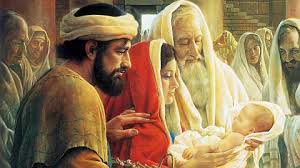


The text for this meditation is written in the 2nd Chapter of the Gospel according to St Luke: Verses 22 - 40


22 And when the time came for their purification according to the Law of Moses, they brought him up to Jerusalem to present him to the Lord 23 (as it is written in tthe Law of the Lord, “Every male who first opens the womb shall be called holy to the Lord”) 24 and to offer a sacrifice according to what is said in the Law of the Lord, “a pair of turtledoves, or two young pigeons.” 25 Now there was a man in Jerusalem, whose name was Simeon, and this man was righteous and devout, waiting for the consolation of Israel, and the Holy Spirit was upon him. 26 And it had been revealed to him by the Holy Spirit that he would not see death before he had seen the Lord’s Christ. 27 And he came in the Spirit into the temple, and when the parents brought in the child Jesus, to do for him according to the custom of the Law, 28 he took him up in his arms and blessed God and said,  
29  “Lord, now you are letting your servant depart in peace, 
according to your word; 
30  for my eyes have seen your salvation 
31  that you have prepared in the presence of all peoples, 
32  a light for revelation to the Gentiles, 
and for glory to your people Israel.” 
33 And his father and his mother marvelled at what was said about him. 34 And Simeon blessed them and said to Mary his mother, “Behold, this child is appointed for the fall and rising of many in Israel, and for a sign that is opposed 35 (and a sword will pierce through your own soul also), so that thoughts from many hearts may be revealed.” 
36 And there was a prophetess, Anna, the daughter of Phanuel, of the tribe of Asher. She was advanced in years, having lived with her husband seven years from when she was a virgin, 37 and then as a widow until she was eighty-four. She did not depart from the temple, worshiping with fasting and prayer night and day. 38 And coming up at that very hour she began to give thanks to God and to speak of him to all who were waiting for the redemption of Jerusalem. 
39 And when they had performed everything according to the Law of the Lord, they returned into Galilee, to their own town of Nazareth. 40 And the child grew and became strong, filled with wisdom. And the favour of God was upon him.

As written in the Old Testament Book of Exodus (Exodus 13:1–2) The Law of Moses concerning the first born is fairly clear:
The Lord said to Moses, “Consecrate to me all the firstborn. Whatever is the first to open the womb among the people of Israel, both of man and of beast, is mine.”
When God freed the Children of Israel from the slavery of Egypt, He sent the angel of death to slaughter the first born of every man and animal in the land of Egypt.  The angel of death only spared those households that had the sign of the blood of the lamb painted on their doorposts.  From that moment on, God claimed the firstborn of every man and animal.  As Mary’s firstborn, Jesus had to keep this law.  The law required Mary and Joseph to bring Jesus to the temple and consecrate Him to the Lord.
The law also spoke about mothers who had just given birth (Leviticus 12:1–4). The Lord spoke to Moses, saying, “Speak to the people of Israel, saying, “If a woman conceives and bears a male child, then she shall be unclean seven days. As at the time of her menstruation, she shall be unclean. And on the eighth day the flesh of his foreskin shall be circumcised. Then she shall continue for thirty-three days in the blood of her purifying. She shall not touch anything holy, nor come into the sanctuary, until the days of her purifying are completed.” – and following on:
(Leviticus 12:6–8) “And when the days of her purifying are completed, whether for a son or for a daughter, she shall bring to the priest at the entrance of the tent of meeting a lamb a year old for a burnt offering, and a pigeon or a turtledove for a sin offering, and he shall offer it before the Lord and make atonement for her. Then she shall be clean from the flow of her blood. This is the law for her who bears a child, either male or female. And if she cannot afford a lamb, then she shall take two turtledoves or two pigeons, one for a burnt offering and the other for a sin offering. And the priest shall make atonement for her, and she shall be clean.”
According to the law God handed down to Moses, mothers who had just given birth were traditionally unclean for forty days after giving birth to boys and eighty days after giving birth to girls.  At the end of that time they had to present themselves for purification.  This was a blessing in disguise.  You see, anyone who was unclean was forbidden from participating in the normal routine of the community.  For a woman, this included the normal household duties.  The indirect result was that she was forced to rest up for forty days, or eighty days in the case of a baby girl, before she could re-join the community and resume her normal duties.
So, we have one reason for Joseph to take Jesus to the temple, and another reason take Mary to the temple.  That is simply to fulfil to requirements of the Law in one visit; to perform the presentation of the firstborn and the purification of the mother on the same day.  So it is that today’s Gospel informs us that Joseph brought Mary and Jesus to the temple in order to perform these rituals.
Normally this is something that would happen on a day to day basis in those times; but things are a little different in this case.  Consider who this little child is.  This little child is the Word made flesh.  He is God incarnate.  This temple is His temple.  The sacrifices in this temple are made to Him. Joseph is taking Jesus to the temple to place Him under the law when in fact He is the Law and He is the only living human who perfectly keeps the Law.  In a way, the consecration of Jesus will be to Himself.
In addition to that, the temple itself is the place where God dwells with His people.  That means that the baby that Mary and Joseph carry into the stone temple is, in fact, the living temple of flesh and blood … Immanuel, God with Us.  So Mary and Joseph are bringing the living, breathing temple into the stone temple.  There are all kinds of amazing things happening as the infant Jesus enters His holy temple.
Then there are these two Old Testament saints waiting for Jesus … Simeon and Anna.  The Holy Spirit had given Simeon a special promise.  It had been revealed to him by the Holy Spirit that he would not see death before he had seen the Lord’s Christ. (Luke 2:26) Anna was also ready for she did not depart from the temple, worshiping with fasting and prayer night and day.” (Luke 2:37)
Modern day Christians have lectionaries and routines of worship which can be taken for granted. It was very different for the faithful who lived at the time of Jesus.  The Old Testament Christians are saved by faith in the Christ who will come sometime in their future.  The New Testament Christians are saved by faith in the Christ who has already come in their past.  Then there was those faithful people who lived in those miraculous, confusing and turbulent years between the time Jesus was born and the time He ascended.  One can only wonder as to the essence of their faith and just what they believed.
Simeon and Anna provide one answer to that question.  The Holy Spirit guided Simeon into the temple at the exact right time so that he was waiting for Jesus when Mary and Joseph brought Him into the temple.  Anna was always in the temple, so that she was also ready when the Lord came.  These two remind us that God never abandons His people, but always preserves them in His salvation.
The reaction of Simeon to the presence of the Christ-child is marvellous.  Parents do not ordinarily allow strangers to take their babies from them.  Perhaps there was something special in Simeon’s face when he approached Mary and Joseph, or it may be that Mary and Joseph already knew Simeon from some other time.  At any rate, Jesus ended up in Simeon’s embrace.
Clearly Simeon knew exactly who he enfolded in his embrace.  As he looked down into the face of this infant, he prayed, not to the heavens, but to the baby in his arms, “Lord, now you are letting your servant depart in peace, according to your word; for my eyes have seen your salvation that you have prepared in the presence of all peoples, a light for revelation to the Gentiles, and for glory to your people Israel.” (Luke 2:29–32) Simeon’s faith was in the baby who lay in his arms.
I imagine that Simeon was reluctant to give the infant back to Mary and Joseph, but as he did, he had a word for them as well.  Simeon blessed them and said to Mary his mother, “Behold, this child is appointed for the fall and rising of many in Israel, and for a sign that is opposed (and a sword will pierce through your own soul also), so that thoughts from many hearts may be revealed.” (Luke 2:34–35) Even in this account from Jesus’ infancy, we already see God preparing Mary for the road ahead.  The Holy Spirit spoke through the mouth of Simeon to begin preparing Mary for that day when she would look upon this son as He hung on a cross and paid for the sins of the world.  When the Virgin saw that her innocent Son had been condemned, it cut through her heart, especially his crucifixion.  She was not the only one who had to see and experience the malice of the world.  Indeed the entire Christian Church at all times experiences a mixture of shame, gratitude and heart break as she observes the price God paid to redeem us from sin.
Anna also believed, for although we do not have her exact words, Luke provides a description of her activity as she began to give thanks to God and to speak of him to all who were waiting for the redemption of Jerusalem. (Luke 2:38) She proclaimed this infant as the redeemer.
The events of today’s Gospel finally come to a close as Luke once again reminds us that Joseph, Mary, and Jesus had done everything according to the law.  So we see that even as an infant when, from a human point of view, Jesus was absolutely helpless, God still worked through Joseph and Mary so that Jesus kept the law perfectly.  In this way, we see that Jesus was already our substitute under the law even though He was only a tiny baby.
When we combine this obedience with the piercing of the heart that Simeon spoke of, we see that the Gospel already teaches that Jesus will fulfil the law of God perfectly until His innocent sacrifice on the cross where He will totally redeem the entire world from sin.  So we see that even as an infant, the Lord was already on the path that led to the cross.
The church today joins Simeon and Anna as we too celebrate the coming of the Lord to His people.  We even join in Simeon’s song as we also have seen and even tasted the Lord’s salvation as He comes to us in His body and blood.  Just as the Holy Spirit worked in Simeon to bring him into the temple to see the Lord’s Salvation, so also the Lord has given us His sacrament so that we may also see the Lord’s salvation as we eat His body and drink His blood.  So it is that the Lord will always dwell with His people and give them His gifts.  Amen

The peace and love of our Great Triune God that is beyond all human understanding, keep your hearts and minds in Christ Jesus. Amen


Thursday, 21 December 2017

Advent 4 – 24 December 2017 – Year B

Grace to you and peace from God our Father and our Lord and Saviour Jesus Christ. Amen


The text for this meditation is written in the 1st Chapter of the Gospel according to St Luke: Verses 26 – 38:

26 In the sixth month the angel Gabriel was sent from God to a city of Galilee named Nazareth, 27 to a virgin betrothed to a man whose name was Joseph, of the house of David. And the virgin’s name was Mary. 28 And he came to her and said, “Greetings, O favoured one, the Lord is with you!” 29 But she was greatly troubled at the saying, and tried to discern what sort of greeting this might be. 30 And the angel said to her, “Do not be afraid, Mary, for you have found favour with God. 31 And behold, you will conceive in your womb and bear a son, and you shall call his name Jesus. 32 He will be great and will be called the Son of the Most High. And the Lord God will give to him the throne of his father David, 33 and he will reign over the house of Jacob forever, and of his kingdom there will be no end.” 
34 And Mary said to the angel, “How will this be, since I am a virgin?”
35 And the angel answered her,  “The Holy Spirit will come upon you, and the power of the Most High will overshadow you; therefore the child to be born will be called holy—the Son of God. 36 And behold, your relative Elizabeth in her old age has also conceived a son, and this is the sixth month with her who was called barren. 37 For nothing will be impossible with God.” 38 And Mary said, “Behold, I am the servant of the Lord; let it be to me according to your word.” And the angel departed from her.

One of the things that the great reformers had to deal with during the reformation was the role of the Virgin Mary in the church.  Even today, the place accorded to Mary in the official teaching and popular devotion of the Roman Catholic Church remains one of the major differences that separate it from other mainstream Christian denominations.
One of the questions the reformers asked was, “Is it right to call Mary the “Mother of God?”  One of the difficulties with this title is that many think it is elevating Mary above her station.  However, a little thought helps us understand that when we call Mary the “Mother of God,” we are actually acknowledging the special nature of Jesus who is both God and man.  If we acknowledge that Mary is the true mother of Jesus and if we acknowledge that Jesus is true God, then, by definition, Mary actually is the “Mother of God.”  When we say that Mary is the “Mother of God,” we are really not saying anything special about Mary.  We are, in fact, proclaiming that her son, Jesus Christ, is not only true man, but He is also true God.
This gives us the ability to say all kinds of things about Mary and Jesus that force us to think about who Jesus really is.  When we see Jesus dying on the cross, we see God dying on the cross.  When we recognise that Jesus, the Son of God, is fully human, we recognise that a human being is a member of the Triune God.
In today’s Gospel we heard the angel Gabriel tell Mary that she was to become the “Mother of God.”  Gabriel told her that her son would also be the Son of the Most High.  When Mary asked for more details, Gabriel provided them.
The Holy Spirit worked the miracle that would provide the DNA that was missing from Mary’s egg … the part that the husband normally provides.  At the instant the Holy Spirit did that, God the Son took up residence in the womb of the Virgin.  He took human flesh unto Himself.  From that moment on, the Christ would forever be both true God and true Man.
Think about that.  That little one cell egg that the Holy Spirit fertilised is God.  As that cell divided and matured, God would seek out and attach Himself to the wall of Mary’s womb.  The umbilical cord would form.  Mary’s body would provide nutrition and oxygen and expel waste and carbon dioxide back and forth from the sinful blood of Mary to the holy blood of God our saviour.  For nine months, Mary’s body sustained the body of God.  Think what an amazingly complex biological and spiritual process we describe with the simple words of the Creed … conceived by the Holy Spirit … born of the Virgin Mary.
Mary will forever be the “Mother of God,” but for nine months she was also the temple of God.  Again, we are not saying that Mary is some sort of supernatural being, nor are we saying that she is made of superior stuff compared to other women.  Instead, we are simply saying that for nine months God revealed His presence in her womb.  The temple is the temple because it is the place where God reveals His presence with His people.  Mary is the temple because God in the flesh was present within her.
Now, as spectacular as this all is, there is a real problem here for Mary.  From all outward appearances, this pregnancy will look like any other pregnancy.  That is the whole point.  The Son of God is to experience every aspect of human life as a full human.  The entire community will look at Mary and see a perfectly natural pregnancy.  That means that Joseph, her betrothed husband will see it as a normal pregnancy.  Mary’s parents will see it as a normal pregnancy.  How will she explain this to them?  “Joseph … Mom … Dad … this baby is from the ah … the ah … Holy Spirit.”  At the very least, this pregnancy could destroy her reputation.  If she was publicly convicted of adultery, the penalty was death.
Why did God do this to Mary?  For that matter, why did the Son of God submit to taking human nature unto Himself?  Why go through all this inconvenience … this hardship … this shame?  Why submit to this biological and sociological mess?
In this miracle, we already see our salvation at work.  After all, the Bible tells us that Mary, like all human beings, was born in sin.  Like all human beings, she deserved eternal punishment.  The Holiness of God in her womb should have destroyed her sin and her along with it, but it did not.  Instead, God came to be with her to bless her.  The Holy Son of God had taken up His human flesh inside of her.  He had already taken His first step on the road to the cross.  The salvation He earned on the cross as both God and Man was already at work protecting Mary from the condemnation she deserved because of her sin.
The Lord did not come into human flesh merely to protect His mother from destruction, but He also came to protect you and me from destruction.  During this coming week, we will celebrate the human birth of God in the flesh, Jesus Christ.  We will celebrate the fact that God and man come together in one person – Jesus the Christ – the Son of Mary – the saviour of the world.  His conception by the Holy Spirit and His birth of the Virgin are the beginning of His journey to save us.  During His journey, He will live a life without sin, He will teach and heal, He will suffer, die, and be buried.  He will rise and ascend back to His Father in Heaven.  He will do all this so that He could come to us without punishing us for our sin.  He will do all this so He could be with us and we could be His favoured people.
Jesus’ journey will remove our sins from us so that they can be punished without punishing us.  As the little human egg that began to divide in the womb of the Virgin, Jesus already carried our sin.  Even though He will never sin in His entire life, the time will come when God will treat Him as the greatest sinner who ever lived.  The little human egg in the womb of the Virgin will grow up to suffer the forsakenness of God as He hangs from the cross.  The wrath of God over sin will pour out on Him so that it does not need to pour itself out on us.  Instead God can come to us with His mercy, grace, and love.  God can be with us and we will be His favoured people.
The justice of God will proclaim its satisfaction with this sacrifice.  The human body that began growing in the Virgin will rise out of the grave and ascend to the Father in Heaven.  From there He will come to all who believe in Him.  He will bring heaven to them.  He will be with them and they will be His favoured people.
Gabriel uttered God’s message to Mary over two thousand years ago.  The promise in those words has come to pass.  The baby was born and Mary named Him Jesus just as Gabriel had said.  Jesus kept all the promises that God had made.  His life was perfect in every way.  Never the less, even though His life was perfect, He suffered the cruelty of death on a cross.  Because His death conquered sin, death could not hold Him and He rose from the dead just as He had promised.
Before Jesus ascended to heaven, He made a promise.  [Matthew 28:20] “Behold, I am with you always, to the end of the age.”  He continually comes to us and He is always with us.  If Gabriel were to appear to us this day, he could greet us with the same greeting that he gave to Mary.  He could say, “Greetings, O favoured people of God, the Lord is with you!”  This would not be just a polite greeting, but it would be a statement of fact.  For the facts are these: that little single-celled God in the womb of the Virgin grew up to make us people of God and for His sake, the Lord really is with us.  Amen
The love and peace of our Great Triune God that is beyond all human understanding, keep your hearts and minds in Christ Jesus. Amen


Thursday, 7 December 2017

Advent 2 – 10 December 2017 – Year B

Grace to you from God our Father and our Lord and Saviour Jesus Christ. Amen
The text for this meditation is written in the 1st Chapter of the Gospel according to St Mark: Verses 1–8:

The beginning of the gospel of Jesus Christ, the Son of God.
2 As it is written in Isaiah the prophet,
 “Behold, I send my messenger before your face, 
who will prepare your way, 
3 the voice of one crying in the wilderness: 
 ‘Prepare the way of the Lord, 
make his paths straight,’ ” 
4 John appeared, baptizing in the wilderness and proclaiming a baptism of repentance for the forgiveness of sins. And all the country of Judea and all Jerusalem were going out to him and were being baptized by him in the river Jordan, confessing their sins. Now John was clothed with camel’s hair and wore a leather belt around his waist and ate locusts and wild honey. And he preached, saying,  “After me comes he who is mightier than I, the strap of whose sandals I am not worthy to stoop down and untie. I have baptized you with water, but he will baptize you with the Holy Spirit.” 


In our modern daily lives we are continually being exposed to an age old technique of delivering a message, it is called ‘Repetition for effect’. Television advertising and political speeches are two prime examples.  ‘Repetition for Effect’ is a subtle technique that repeats the same message over and over again using different words with the purpose of implanting that message in our sub conscious thinking. It is not all about cunning manipulation; the very same method has been used positively by famous orators and authors; even the authors of the Holy Bible.
Isaiah used this repetition effect in today’s Old Testament reading: “In the wilderness prepare the way of the LORD; make straight in the desert a highway for our God.  Every valley shall be lifted up, and every mountain and hill be made low; the uneven ground shall become level, and the rough places a plain.”  “Make straight,” “Lift up the valley,” “lower the mountains and hills,” “Level the uneven ground,” “make the rough places plain,” – how many ways are there to prepare a way?  Isaiah really wants us to know that preparing the way for the Lord is vitally important.  He used the repetition effect to make his point.
As powerful as ‘Repetition for effect’ is, in our Gospel reading we see Mark taking it one step further.  He builds up one idea using the repetition effect method and then simply goes on to say that there is a second idea that is even greater than the first.  Today’s Gospel tells us that John is really great, but Jesus is even better.
Mark begins his account of the Gospel by talking about John.  He begins to build up John by showing us that here is a prophet who fulfils prophecy.  As it is written in Isaiah the prophet, “Behold, I send my messenger before your face, who will prepare your way, the voice of one crying in the wilderness: ‘Prepare the way of the Lord, make his paths straight,’ ” This already makes John important, but Mark isn’t finished describing John yet.
Mark intensified John’s greatness by saying, “All the country of Judea and all Jerusalem were going out to him and were being baptised by him in the river Jordan, confessing their sins.”  So John is not only the fulfilment of prophecy, but he is also the instrument of the Holy Spirit to bring repentance and baptism to the Jordan River.  Mark makes it very clear that John was a key player in God’s plan for salvation.
Then, as we are pretty much convinced that Mark’s account in the Gospel is really about John, we hear John himself say, “After me comes he who is mightier than I, the strap of whose sandals I am not worthy to stoop down and untie.  I have baptised you with water, but he will baptise you with the Holy Spirit.”  Mark has told us that John is important – that he is great, but even that is not enough to make John worthy to untie the sandal strap of the one who follows him.  As great as John is, he is still a sinner.  Even as John baptised in the wilderness and proclaimed a baptism of repentance for the forgiveness of sins, he himself needed that forgiveness.
Every time I read this passage from Mark I get a total reality check on the state of my humanity: “If someone as great as John can’t even reach Jesus’ sandal straps, what chance do I have?”  Think about it.  John is the last of the Old Testament prophets.  He is also the greatest of the Old Testament prophets.  There are even prophecies written about him.  If he is too sinful to even untie the sandals of Jesus, then my guilt is even worse.  If John is nothing compared to Jesus, then I haven’t got a chance.
This whole human logic thinking totally emphasises the reason that the Gospel of Jesus Christ is such good news.  It tells us that God knows we can’t reach up to Him and therefore, He reaches down to us.  We can’t come to Him, so He comes to us.
Yet it is not feasible for God to simply come to us.  If He did that, His holiness would destroy our sin and us along with it.  God must come to us in a way that takes our sin away from us so that His justice can punish the sin without destroying us.  Mark’s Gospel account tells us that Jesus, the Son of God comes in that special way.  He comes as the Christ.
Jesus Himself tells us what it means to come as the Christ.  He said, [Luke 24:46] “Thus it is written, that the Christ should suffer and on the third day rise from the dead.”  When Mark tells us that his writing is “The beginning of the gospel of Jesus Christ, the Son of God,” he is already telling us that Jesus is the one who will suffer and rise on the third day.  In fact, as you hear the Christmas story, you will constantly hear of the Christ who is born of Mary.  This is the same as saying that the one who will suffer and rise from the dead who is born of Mary.
God comes to us in a totally unexpected way.  Even though we are not worthy to touch His sandal straps, He comes to us in ordinary human flesh.  Even though we are not worthy to touch His sandal straps, He walked a lifetime in our sandals and He did it without sin.  He comes in this way so that He could take our sin up from us into Himself.    He comes in this way so that He could take the punishment for our sin into Himself.
Even though we are not worthy to touch His sandals straps, He allowed mere men to nail Him to a cross.  It was from the apparent weakness of that cross that Jesus demonstrated His greatest might.  In the apparent defeat of death, Christ conquered death.  He became the solution for sin by taking our sin onto Himself and paying the price for it.  As He walked in our sandals on the way of death He took away our sin and covered us in His holy righteousness.  Now God can come to us without condemnation.  Now God can come to us in joy.
John, the greatest of the Old Testament prophets baptised with water.  Jesus baptises with the Holy Spirit.  By that Holy Spirit we receive the gift of faith in Jesus.  It is by that faith that we receive all the gifts that Christ comes to give us.  It is through that gift of faith in Jesus that we receive forgiveness, life, and salvation.  Through that gift of faith God comes to us in joy.
During Advent we contemplate the ways that God prepares us for His coming and no one was more into that preparation than John the Baptist.  John was the last and greatest of the Old Testament prophets.  He is the hinge between the Old Testament and the New Testament.  He is so important that God inspired prophets such as Isaiah, Malachi, and others to foretell his coming.  The Holy Spirit inspired Mark to quote from Isaiah.  John the Baptist is “The voice of one crying in the wilderness: Prepare the way of the Lord and so forth.  Even Jesus had words of praise for John.  He said, [Matthew 11:11] “Truly, I say to you, among those born of women there has arisen no one greater than John the Baptist.”
Never the less, John had to confess that he was not worthy to enter God’s presence.  He fully understood that he was a sinner who deserved nothing but punishment from God.
In light of that, we too must confess that we are sinful and unclean, that we have sinned against God in thought, word, and deed.  We, like John, deserve nothing but punishment from God.
As a key player in God’s plan for our salvation, John pointed to the one who followed him, Jesus.  The Holy Spirit inspired Mark to begin his account of the Gospel with a clear confession that Jesus is the Christ, the Son of God.  As we learn what it means to be the Christ, we learn that Jesus is the one who lives for us, who suffers for us, who dies for us, and who returns to life for us.  We learn that Jesus is the way that God comes so that we can have life and have it abundantly (John 10:10).
In this season of Advent, this season of coming and preparing, God reminds us that it is He who comes and He who prepares.  He came once to prepare the way of salvation for all mankind.  He still comes to prepare that way in us.  He will come to take those whom He has prepared to live with Him forever. Let us all earnestly pray this Advent Season that all would hear God as He comes so that He would prepare them for His Last Coming.  Amen
The love and peace of our Great Triune God that is beyond all human understanding, keep your hearts and minds in Christ Jesus. Amen