Sunday, 20 June 2021

Pentecost 4 – 20 June 2021 – Year B

Grace to you and peace from God our Father and our Lord and Saviour Jesus Christ. Amen
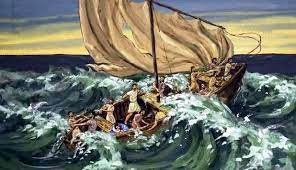


The text for this meditation is written in the 4th Chapter of the Gospel according to St Mark: Verses 35 – 41:

 On that day, when evening had come, he said to them, “Let us go across to the other side.” 36 And leaving the crowd, they took him with them in the boat, just as he was. And other boats were with him. 37 And a great windstorm arose, and the waves were breaking into the boat, so that the boat was already filling. 38 But he was in the stern, asleep on the cushion. And they woke him and said to him, “Teacher, do you not care that we are perishing?” 39 And he awoke and rebuked the wind and said to the sea, “Peace! Be still!” And the wind ceased, and there was a great calm. 40 He said to them, “Why are you so afraid? Have you still no faith?” 41 And they were filled with great fear and said to one another, “Who then is this, that even the wind and the sea obey him?”


The incident recorded for us in the Gospel we just heard is not just a nice story about Miracle Worker Jesus saving His followers from a watery grave.  It is also gives us real insights concerning the nature of Jesus as the Christ and the nature of the sinners in the boat with Him.


The events leading up to the account in today’s Gospel include a very full day of teaching for Jesus.  We heard two of the parables He taught in last week’s Gospel.  It’s been a long day.  Jesus is tired.  As is often the case after a busy time of ministry, Jesus decided to get away with His disciples for some much-needed rest and relaxation.  In this case, He elected to sail in a boat, with His disciples, to the other side of the Sea of Galilee.


The Sea of Galilee (also known as Lake Gennesaret) is about thirteen kilometres across from West to East at its widest point.  It is situated some 213 metres below sea level and surrounding the sea, the hills of Galilee reach 450 metres above sea level and the Golan Heights (called the Decapolis in Jesus time) reach more than 750 metres. The sea’s location makes it subject to sudden and violent storms as the wind comes over the Eastern mountains and drops suddenly into the sea. The cold air, being heavier, drops as the warm air rises. This sudden change can produce surprisingly furious storms in a short time.


On calmer water with a good sea breeze, the sailing boat crossing should only take a few hours, but on this crossing, a storm came up.  Now, even though several of the disciples were experienced fishermen, they were still frightened.  This indicates that the storm was powerful.


Where was Jesus during this storm?  In these boats there was a ‘VIP seat’ for travelling guests. A little seat in the stern of the boat with a cushion and a carpet, and He was reclined in this seat blissfully sleeping.  He was exhausted from His long day and fell into a sleep so sound that even the storm did not wake Him.


The fact that Jesus was asleep is a revealing demonstration of the nature of the Christ.  Other than His actual death on the cross, there is no better demonstration of the humanity of Jesus than the sleep of exhaustion.  Every human being on the planet knows what it is to grow tired and fall asleep.  Here Jesus demonstrates His unity with all people.  He sleeps like any other human being.


But then the disciples wake Him and ask for His help.  The question in my mind is why did they wake him? It’s true that by this time, the disciples had seen Jesus do some miraculous healing and heard some of His wise teachings, but these men did not have a good track record of faith in and understanding of Jesus mission. So, we should not assume that the disciples were expecting much from Jesus.  After all, he was brought up as a carpenter, not as a sailor.  But, He was their leader and teacher, and they were in a panic, so they took the problem to Him. I mean how could he sleep through all this anyway? At the very least he could be another set of hands to help bail the water out of the boat or some other similar activity.  


I am inclined to think that they were overwhelmed, and Jesus was their last hope, so they woke Him to get Him involved. Ever get that feeling of despair? You know you feel you’re in deep trouble, with no answers in sight, and, pardon the pun, you feel as though you’re in the same boat as the Disciples that night. The thing is though, when they woke Jesus, I am sure they did not expect what happened next.


Jesus woke up and had a word with the elements.  The word “rebuke” in the text means that Jesus scolded the wind and the water rather harshly.  After that, the wind and the water became calm.


Now, you and I could scold the weather until we were blue in the face, and nothing would change.  In fact, if we continued in that sort of activity, people might wonder if they should take us somewhere to get a mental check-up. 


 Jesus, on the other hand, scolded the weather and the weather paid attention.  It paid attention because Jesus is not just your ordinary, sleepy human being.  He is also the God of all creation.  

Jesus’ ability to control the wind and the waves with just a word clearly shows that He is God.  So it is that this one event very clearly demonstrates that Jesus is both 100 % man and 100 % God in one person.


The disciples may have been full of fear on account of the storm, but, on the other hand, when they witnessed Jesus calm the storm, they were terrified.  The original Greek says that they feared a great fear.  They were in a boat with someone who could talk to the wind and the waves, and the wind and the waves would pay attention to what He said. 


 They began to question who their master and teacher really was. Isn’t it a sad indictment on out human nature that we have to be shocked into belief? When we don’t really come to terms with our sinful nature until we realise we are in the presence of God Himself? Why else would they have great fear? They realised they could be riding in the same boat as the God of creation.


This is one of the themes in Jesus’ life.  People often ask who Jesus is.  Today, we heard that the wind and the waves know who Jesus is.  In other parts of the Gospel account, we learn that diseases, birth defects, and injuries know who Jesus is.  Even the demons know who Jesus is.  But, when it comes to the human beings, Jesus is a great mystery.  They regularly ask, “Who is this?  Where does He get this authority?”  This reminds me of the words that the Holy Spirit spoke through His prophet Isaiah. (Isaiah 1:3) “The ox knows its owner, and the donkey its master’s crib, but Israel does not know, my people do not understand.”  


All through the Old Testament whenever God appeared, there was great fear. You see it is not until God’s presence becomes obvious in our lives do we realise how sinful and inadequate we are. 

The terror of God traces its way clear back to Eden.  God called and Adam replied, (Genesis 3:10) “I heard the sound of you in the garden, and I was afraid.” Adam had sinned and the presence of the holy and almighty God terrified him.  It is the same for all people who see their sin clearly in the holy presence of Almighty God.  (Hebrews 10:31) “It is a fearful thing to fall into the hands of the living God”.


That is the reason it so important that Jesus be both man and God.  If Jesus were only God, He could not take our place under the law and live a holy life for us.  He also could not suffer the penalty we have earned for our sin.  If Jesus were a man, and nothing more, then His perfect life and sacrificial death would earn the salvation of one and only one person.  The rest of the world would be lost.  It is essential for our salvation that Jesus be both God and man.


We need the salvation that Jesus provides because the storm on the Sea of Galilee is just one instance of the many disasters that the sin of humanity has brought into this world.  The destruction that storms bring is an expression of the curse that came when sin entered the world.  Our sin not only brings sickness and death to us, but even the world is cursed.  The Holy Spirit inspired Paul to write to the Romans: (Romans 8:22) “We know that the whole creation has been groaning together in the pains of childbirth until now”. Floods, fires, cyclones, tornadoes, hail, lightening, earthquakes, and all the other natural disasters are the result of the curse that our sin brought into the world.


These natural disasters are not the only limited to the storms that our sin has brought into the world.  There are other adversities in our lives as well.  There are the medical storms of infections, heart disease, diabetes, strokes, cancer, and so forth.  There are the relational storms of broken families and friendships.  There are the financial storms of businesses closing and staff layoffs.  Ultimately, there is the storm of death that comes to all of us sooner or later.  We may try to deny the existence of sin in our lives, but these storms, both private and public, say otherwise.


It is in the incarnation of Jesus Christ – the fact that the Son of God assumed human nature – that we see God’s loving plan to deal with sin.  In Jesus Christ, God assumed human nature to save humans from their nature – their sinful nature.  It is our own original sin that doomed us to perish – not just from this earth, but also from the blessings of God’s presence with us.  


The good news of the Gospel is clearly announced to us in (1 John 1:7) “But the blood of Jesus [God’s] Son cleanses us from all sin”. Christ’s human nature allowed Him to be the target of God’s wrath as He hung on the cross for our sake.  Christ’s Divine nature allowed Him to endure that wrath for all people in all times and places.  So it is that God took on human flesh and saved us from our sins.


We can have complete confidence in that salvation that Jesus earned for us because death was unable to hold Him.  For Christ did not remain in the grave, but, after He conquered death, He rose from death never to die again.  After He rose, He showed Himself to His disciples.  He encouraged them to examine the marks of the cross in His body.  He talked with them and ate with them.  He interacted with them in very human ways.  At the same time, locked doors and windows were no barrier to Him as He appeared and disappeared at will.  In His resurrection, He demonstrated that He lives forever as both God and man in one person.


Jesus Christ is both fully God and fully man.  With that combination, we find our full salvation from sin, death, and the power of the devil.  In His humanity, He was able to suffer on the cross in our place and for our good.  In His deity, He was able to defeat our foes and rise from the dead to give us eternal life.  It is in the person of Jesus Christ who both slept and stilled the storm that we have confidence that He will still the storms in our life. 


The vital question for us is, when our boat is rocking and the storms are raging in our lives, are we prepared to wake Jesus in prayer? Do we have the faith to be confident that, regardless of the circumstances, He will bring calm and peace back into our lives? Hear His promise (Matt 11:28-30) “Come to me, all you who are weary and burdened, and I will give you rest. 29 Take my yoke upon you and learn from me, for I am gentle and humble in heart, and you will find rest for your souls. 30 For my yoke is easy and my burden is light.”. Amen


The love and peace of our Great Triune God that is beyond all human understanding, keep your hearts and minds in Christ Jesus. Amen

Thursday, 10 June 2021

Third Sunday After Pentecost – 13th June 2021 – Year B

Grace to you and peace from God our Father and our Lord and Saviour Jesus Christ. Amen


The text for this meditation is written in the 4th Chapter of the Gospel according to St Mark: Verses 26 – 34:

26 He also said, “The kingdom of God is as if someone would scatter seed on the ground, 27 and would sleep and rise night and day, and the seed would sprout and grow, he does not know how. 28 The earth produces of itself, first the stalk, then the head, then the full grain in the head. 29 But when the grain is ripe, at once he goes in with his sickle, because the harvest has come.”

30 He also said, “With what can we compare the kingdom of God, or what parable will we use for it? 31 It is like a mustard seed, which, when sown upon the ground, is the smallest of all the seeds on earth; 32 yet when it is sown it grows up and becomes the greatest of all shrubs, and puts forth large branches, so that the birds of the air can make nests in its shade.”

33 With many such parables he spoke the word to them, as they were able to hear it; 34 he did not speak to them except in parables, but he explained everything in private to his disciples.


Today is one of those days when a sermon seems almost counter-productive.  Why?  Well…the words of Jesus in our Gospel lesson are quite simple and easy to understand.  This is basic teachings.  Mostly everyone has heard and knows the parables of sowing seed and the tiny mustard seeds growing into the grandest and largest plants in all the garden, and to mostly everyone the words are self-explanatory.  And even if you are unfamiliar with these parables, it doesn’t take a rocket scientist to “crack the code” and decipher a fairly obvious meaning.  Sow the seed of God’s Word!  It’s all so simple.  A sermon almost seems unnecessary, like we’re just “gilding the lily.”

But…in saying that…. All too often we come at these parables from a very methodical, practical perspective.  Basically, we tend to look only as far as the “how to” being taught but we never get to the “why.” WHY did Jesus teach these parables?  You see, the real lesson to be learned here is found in the reason for Christ’s teaching; not in the method that is taught.

Why did Jesus teach this lesson to His disciples; His followers?  If we look to the parallel accounts recorded for us in Matthew and Luke, we find that the ministry of Jesus was — not surprisingly —under a lot of scrutiny and persecution.  Many people were following Jesus, but many more doubted.  Many more were out to silence Him, mock Him, discredit Him, and even harm Him.  In fact, last week’s Biblical account of Jesus’ own mother and brothers and sisters—His own family—trying to lay hands on Him and silence Him and to take Him home, as if He had a mental illness, bringing great shame upon the family with His behaviour, immediately precedes these parables.  Basically, we hear of Jesus’ own family trying to shut Him up and discredit Him, and then Jesus immediately begins to teach His disciples these lessons about the reign and rule of God and how God works.

When you think about it, it makes perfect sense.  You see, the disciples of Jesus had witnessed a lot of things happening with Jesus’ ministry, and not all of it was good (at least by worldly standards).  In fact, there were many times that Jesus seemed like a rather unloving extremist who was concerned more about right doctrine and practice than He was with establishing relationships and friendships and building up numbers.  There were more than a few occasions that people turned and walked away from Jesus because they didn’t like what He was teaching; they didn’t like what they heard (e.g., the rich young ruler, the crowd of disciples who turned back and no longer walked with Jesus after hearing His teaching on the Bread of Life).  Jesus wasn’t matching up with what they wanted, expected, and demanded, so they took their business elsewhere.  If the customer is always right, then there were more than a few times that Jesus was bad for business.

And it wasn’t just this “bad for business” reality that was alarming the remaining disciples.  There was also the fact that following Jesus could prove hazardous to your health.  John the Baptist certainly found this out the hard way, as would all the apostles.  And don’t think it went unnoticed that Jesus was public enemy number one with the religious elite.  Those were men you just didn’t want to cross.  If you got on the wrong side of the Pharisees and the Sanhedrin, you could expect a high degree of misery in your immediate or short term future.  You see, there’s nothing new under the sun.  People have always tried to avoid conflict and be liked by everyone in the room.  That’s just human nature.  No one likes to be disliked, and yet faithfully following Jesus will make you disliked by a lot of people. 

There’s also the fact that following Jesus wasn’t exactly a fast-track to all the finer things in life.  In fact, following Jesus often put one lower than the animals in terms of finer things and luxuries.  “Foxes have holes and the birds of the air have nests, but the Son of Man has no place to lay His head.” “Take nothing for your journey; no staff, no moneybag, no bread, no money, and do not have two tunics.” “If anyone would sue you and take your tunic, let him have your cloak as well.” So faithfully following Jesus wasn’t exactly the world’s perfect picture of success, which is why many of His own disciples would doubt and despair and turn and walk away.  It’s all bad for business.

Now, I know at this point that it’s rather easy for us to look down upon those “disciples” who turned away from Christ when things didn’t go the way they planned.  After all, we would never do that, would we?  And yet…we do.  We do it all the time.  Just think about how often we try to “help Jesus out” when things aren’t working out the way we anticipated or hoped for.  Just think about how often we try to build a better churchly mousetrap.  You know, every generation of Christians since Christ walked this earth has worried that the Church will die out with them because the younger generations aren’t showing up and packing the pews.  This is when all kinds of interesting stuff gets introduced in the name of “mission” or “church growth.” It’s happened for centuries.  Faithful Word and Sacrament ministry gets put on the back-burner (or forsaken altogether) in favour of the newest gimmicks and marketing ploys and business models, all geared at winning market-share and specific demographics and more money and more people.  We turn our Lord’s Divine Service to us into something that we hope will appeal to the masses, essentially changing God to suit the consumer, rather than letting God change the consumer to suit Him.

Dear friends: This is the reason why Jesus taught these parables.  This is the reason why He still teaches these same parables to us this very day.  In a very real way Jesus is teaching us to stay the course—His course.  He has given us His means of grace as the seed that grows His kingdom.  “Go and make disciples of all nations….” How?  By sowing His seed; that is, by baptising and teaching ALL that He has commanded and taught.  His Word and His Sacraments give life.  New life sprouts forth from these seeds of divine grace, and ONLY from these seeds of His divine grace.  How?  Like the farmer who scatters seeds, he knows not how they sprout and grow.  He just knows that what he sows sprouts and grows.  And the littlest, most unassuming seeds that our Lord plants in us (and gives to us to sow) sprout and spring forth life and peace in the grandest fashion and scale, just like the little mustard seed that grows to become the largest of all the garden plants.

Look no further than right here to your Lord’s feast table.  Look to the very unassuming and scant elements of bread and wine.  Look no further than the baptismal font and the few drops of ordinary water that wet your brow so long ago.  Look no further than this pulpit, this lectern, and this book.  Look no further than the words of absolution you heard and received earlier in this Divine Service.  In all these mere things—these little unassuming mustard seeds—Almighty God is at work, working miraculous, mighty, life-giving, life-saving deeds.  These simple mustard seeds, freely sown with no strings attached—no caveats or conditions—spring forth and produce the fruits of everlasting life.  

Nothing else can do that!  There is nothing else that the world can offer that can produce these fruits and this rich harvest of life, forgiveness, grace, mercy, and peace.  We can try and sow other seeds.  People have been doing it for centuries.  We can try and grow God-pleasing wheat all we want, but if we’re not sowing His seed, all we’re going to find is a crop of weeds (tares) sprouting up.  We can try to doctor up the seeds that God gives us, as if we’re going to improve upon the Master Gardener’s design.  We can try…and we will fail.

This is the reason our Lord teaches this lesson.  Yes—we are called and taught to freely sow the Gospel seeds God gives us.  I will never deny that core teaching of these parables.  But as I said, there’s a very good and Godly reason our Lord teaches us these lessons.  Believe it or not, He does know all that we’re experiencing in this fallen and sinful world.  He does know how His Church is suffering and struggling in the midst of a culture and a people who despise Him, and His means of grace and His holy bride—the Church.  He does know all the things that are eating at us and causing us to doubt, despair, and worry.  He also knows how we tend to respond and behave when life gets tough and things start looking bleak; how we tend to panic and flail about like a person drowning; how we, like our first parents, willingly reach out and sample the goods that the devil, the world, and our sinful flesh hold out to us; how we tend to look elsewhere for the things we think we need to allay our worries and satisfy our desires and give us our version of “peace.” He knows…and He cares.  He loves us and cares for us so much that He still cries out to us and teaches us that He’s got it all covered and under control.  I know it may sound unusual, but these parables of Jesus are just a different way for our Lord to cry out to us in the midst of the storms of life, “Fear not!  Fear not, for it is I, and I am with you always!  Trust in Me above all things.  I’ve got it all in my control.”

I will say it again because it bears repeating, and the ears of faith never tire of hearing the sweet words of the Gospel: Look here at what our Lord and Saviour is sowing, planting, and growing in our midst.  Look at these amazing, yet unassuming mustard seed means of grace…and rejoice!  Here is Christ!  Here is the Master Gardener at work in our life, bestowing upon us His super-abundant harvest of peace that surpasses all human understanding.  Look to and embrace the eternal and unconditional grace given to us in Holy Baptism.  Look to and embrace the mighty life-giving, life-saving Gospel promise in, with, and under the ordinary and unassuming mustard seeds of word, water, bread and wine; the life-giving, life-saving Gospel that sows and produces the fruits of complete forgiveness, everlasting life, and God’s inexhaustible grace, mercy, and peace to all who believe.

In the words of the champion of the Reformation, Dr. Martin Luther, “Here I stand.  I can do no other.” In the same way, Here we stand as the ones who have been called by Christ to freely sow His seeds of grace.  We can do no other, and by His grace we will do no other.  

By the boundless grace of our Triune God,  may we ever and always trust in God above all things, for better or worse, richer or poorer, in sickness and in health, and may we ever and always take shelter in the mustard seed of the bloody cross of Christ; that cruciform mustard seed that, recognised through the eyes and ears of saving faith, gives unconditional and abundant shelter and sustenance and peace to all who hear and believe. Amen

The love and peace of our Great Triune God that is beyond all human understanding, keep your hearts and minds in Christ Jesus. Amen


Wednesday, 2 June 2021

Pentecost 2 – 6 June 2021 – Year B

Grace to you and peace from God our Father and our Lord and Saviour Jesus Christ. Amen


The text for this meditation is written in the 3rd Chapter of the Gospel according to St Mark: Verses 20–35:

20 Then he went home, and the crowd gathered again, so that they could not even eat. 21 And when his family heard it, they went out to seize him, for they were saying, “He is out of his mind.” 

22 And the scribes who came down from Jerusalem were saying, “He is possessed by Beelzebul,” and “by the prince of demons he casts out the demons.” 23 And he called them to him and said to them in parables, “How can Satan cast out Satan? 24 If a kingdom is divided against itself, thatkingdom cannot stand. 25 And if a house is divided against itself, that house will not be able to stand. 26 And if Satan has risen up against himself and is divided, he cannot stand, but is coming to an end. 27 But no one can enter a strong man’s house and plunder his goods, unless he 

first binds the strongman.  Then indeed he may plunder his house.

28 “Truly, I say to you, all sins will be forgiven the children of man, and whatever blasphemies theyutter, 29 but whoever blasphemes against the Holy Spirit never has forgiveness, but is 

guilty of an eternal sin”— 30 for they were saying, “He has an unclean spirit.” 

31 And his mother and his brothers came, and standing outside they sent to him and called him. 32 And a crowd was sitting around him, and they said to him, “Your mother and your brothers are outside, seeking you.” 33 And he answered them, “Who are my mother and my brothers?” 34 And looking about at those who sat around him, he said, “Here are my mother and my brothers! 35 For whoever does the will of God, he is my brother and sister and mother.”


If someone asked me to list the top 100 books that should be on every Christian’s reading list, many of the works of Clive Staples Lewis would make the top half of that list.  Clive Staples Lewis who is commonly known as C.S. Lewis had the great skill of being able to write for many different audiences.  His Chronicles of Narnia series is just right for pre-teens who enjoy fantasy.  His space trilogy is interesting for the fan of science fiction. Mere Christianity and the Problem of Pain help answer some of the hard questions of Christianity.  The Screwtape Letters are an examination of the different strategies that the devil uses to attack our faith.


In Mere Christianity, C. S. Lewis wrote a passage that describes the situation in today’s Gospel.  He wrote:

“I am trying here to prevent anyone saying the really foolish thing that people often say about [Jesus]: I’m ready to accept Jesus as a great moral teacher, but I don’t accept his claim to be God. That is the one thing we must not say. A man who was merely a man and said the sort of things Jesus said would not be a great moral teacher. He would either be a lunatic — on the level with the man who says he is a poached egg — or else he would be the Devil of Hell. You must make your choice. Either this man was, and is, the Son of God, or else a madman or something worse. You can shut him up for a fool, you can spit at him and kill him as a demon or you can fall at his feet and call him Lord and God, but let us not come with any patronising nonsense about his being a great human teacher. He has not left that open to us. He did not intend to. ... Now it seems to me obvious that He was neither a lunatic nor a fiend: and consequently, however strange or terrifying or unlikely it may seem, I have to accept the view that He was and is God.”


In today’s Gospel text we just heard, it began: (Mark 3:20–21) “Then he went home, and the crowd gathered again, so that they could not even eat. 21And when his family heard it, they went out to seize him, for they were saying, “He is out of his mind.” Here, the members of His own household believe that He is a lunatic — ‘on the level with the man who says he is a poached egg’.  Jesus’ family was concerned that Jesus was getting overworked.  Since many in His own family did not yet understand what it meant that He was the Messiah, they thought He was having some kind of nervous breakdown or something.  They desperately wanted to get Him out of the public eye and some place quieter, so He could recover.


After Mark records the response of His family. He records the response of the scribes: (Mark 3:22) “The scribes who came down from Jerusalem were saying, “He is possessed by Beelzebul,” and “by the prince of demons he casts out the demons.” The scribes labelled Jesus as the Devil of Hell.  


Now, the scribes were not wrong to check on Jesus.  During a trial in the book of Acts a man named Gamaliel said, (Acts 5:36–37) “Before these days Theudas rose up, claiming to be somebody, and a number of men, about four hundred, joined him. He was killed, and all who followed him were dispersed and came to nothing. 37After him Judas the Galilean rose up in the days of the census and drew away some of the people after him. He too perished, and all who followed him were scattered.” Apparently, there were other men who gathered a following and claimed to be the Messiah.  The religious leaders in Jerusalem were only being faithful to their calling when they sent representatives to gather facts about Jesus or any other popular teacher.  The problem is not that Jerusalem sent a fact-finding mission out to learn about Jesus.  The problem was with their findings.


Their findings made no sense.  The Gospel according to Mark does not give the exact number of demons that Jesus drove out of people, but the impression is that the number is big.  If Jesus were really possessed, that would make no sense.  It would be like a football player running the wrong way on the field and scoring for the wrong team.  Jesus Himself told them how silly their conclusions were. (Mark 3:23–26)  “He called them to him and said to them in parables, “How can Satan cast out Satan? 24If a kingdom is divided against itself, that kingdom cannot stand. 25And if a house is divided against itself, that house will not be able to stand. 26And if Satan has risen up against himself and is divided, he cannot stand, but is coming to an end”. During Jesus’ ministry, He called the devil and his demons liars, murderers, evil, and so forth, but He never says they are stupid.  The devil and his demons present a united front against God and everyone He loves.  There is no way that a man who drives demons out of people is an ally of those demons.  In fact, He is the demons’ enemy.


Jesus then went on to illustrate what was really happening.  He continued His parable and said, (Mark 3:27) “But no one can enter a strong man’s house and plunder his goods, unless he first binds the strong man. Then indeed he may plunder his house.” The “strong man” in the parable is Satan.  Satan owns the people who have demons.  They are his goods.  Jesus, then, is the stronger man who binds Satan and plunders his goods.  Jesus liberates those whom Satan has bound.


The plan to bind the devil and free his slaves is very old.  Long ago, in Eden, before He took up our human flesh, this same Son of God made a promise to the devil.  (Genesis 3:14–15) “The Lord God said to the serpent, “Because you have done this, cursed are you above all livestock and above all beasts of the field; on your belly you shall go, and dust you shall eat all the days of your life. 15I will put enmity between you and the woman, and between your seed and her seed; he shall bruise your head, and you shall bruise his heel.” In today’s Gospel, we heard how this same Lord God is divinely born of a woman and took on human flesh in order to bruise the head of the serpent.


The bruising that He spoke of in Eden and the binding that He spoke of in the parable are one and the same thing.  It is victory over sin, death, and the power of the devil.  This bruising and binding did not take place with laser lights and fireworks.  Jesus first did what Adam could not do.  He endured the temptation of the devil, but did not sin.  He lived a perfect life.  Then, even though He was innocent, He took up the sin of the world.  (2 Corinthians 5:21) “For our sake [God] made him to be sin who knew no sin, so that in him we might become the righteousness of God”. He endured false trials, cruel physical and emotional abuse, and ultimately death on a cross.  While He hung on that cross, He endured the righteous wrath of God against the sin that He carried … the sin of the entire world.  This He would do for us to bind the strong man, Satan, and free us from our sin.


We know that Jesus’ victory over sin, death, and the devil is complete because the grave was not able to hold Him.  He rose from the dead and proclaimed His victory.  He appeared alive to hundreds of people who testify to His resurrection.


How complete is this victory?  Jesus said, (Mark 3:28) “Truly, I say to you, all sins will be forgiven the children of man, and whatever blasphemies they utter.” These words teach us that the victory is unconditional.  This victory covers every sin of every person in every time and place.  The range of forgiveness is unlimited.


There is one and only one exception to this gracious gift. (Mark 3:29) “Whoever blasphemes against the Holy Spirit never has forgiveness, but is guilty of an eternal sin” To understand the blasphemy against the Holy Spirit, it is important to understand the role of the Holy Spirit in our salvation.  The Holy Spirit is there to create faith in a person and deliver the forgiveness of sins to that faith.  When a person rejects the work of the Holy Spirit, they are rejecting the very forgiveness that He wants to give to them.  Christ earned the forgiveness of sins for them on the cross.  It belongs to them, but they do not have it because they reject it.  They reject the work of the Holy Spirit and so reject the forgiveness that He offers.  This is blasphemy against the Holy Spirit.


The devil, the world, and our own sinful nature want us to reject the work of the Holy Spirit.  They want us to believe that we are spiritual orphans.  But Christ has bound Satan.  He has freed us from the shackles of sin.  We are a member of His family. How can we not ‘accept the view that He was and is God’. Amen


The grace and love of our Great triune God that is beyond all human understanding, keep your hearts and minds in Christ Jesus. Amen